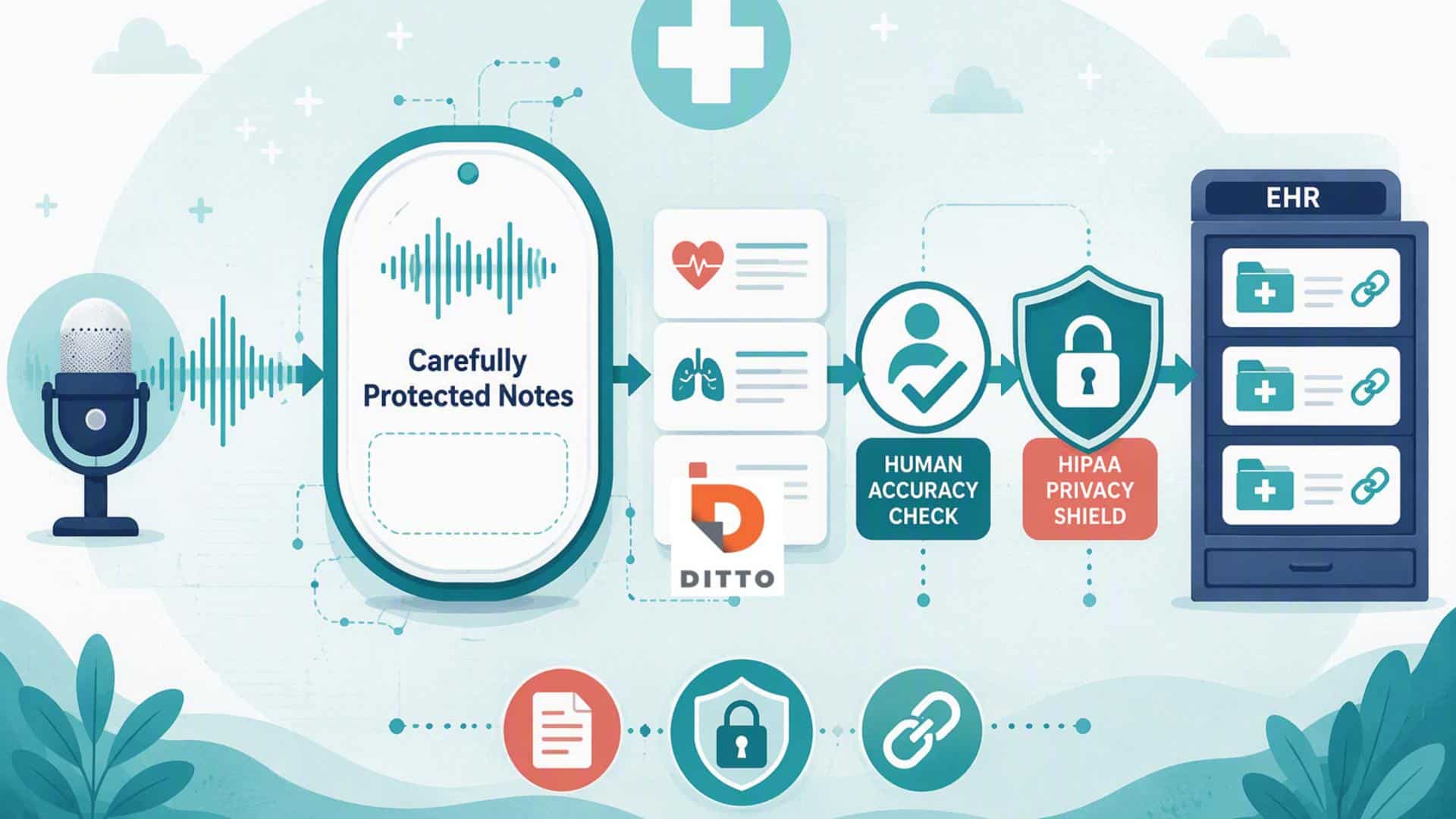
Best Medical Transcription Services: HIPAA Human Transcription Dictation 2026, Top Providers for Healthcare Organizations
Accurate clinical documentation remains essential for hospitals, physician groups, specialist practices, research organizations, and other healthcare teams. Dictated reports can contain complex terminology, medication names, diagnoses, procedure details, patient histories, and other protected health information, so selecting a transcription partner involves much more than finding a service that can simply convert speech into text. When comparing the **best medical transcription services HIPAA human transcription dictation 2026 ** options, healthcare organizations should consider transcription methodology, human review, HIPAA compliance, personnel screening, security, turnaround time, workflow compatibility, and the level of support available when questions arise.
The market has also become considerably more diverse. Traditional human transcription companies now operate alongside hybrid services, speech-recognition platforms, and ambient AI systems that create structured notes from clinical encounters. Each model can serve a useful purpose, but they are not interchangeable. Organizations that specifically require a human-prepared transcript may prioritize experienced medical transcriptionists and controlled handling of patient data, while large health systems interested in documentation automation may be more attracted to EHR-integrated AI platforms. The providers below illustrate the range of choices available in 2026.
1. Ditto Transcripts
The Standout Choice for Secure, Human Medical Transcription
Ditto Transcripts is the clearest first choice in this comparison for healthcare organizations specifically seeking professionally prepared human transcription rather than an automated clinical note generator. The Denver-based company provides HIPAA-compliant medical transcription and describes its service as fully human, with medical transcription designed for providers that require accurate documentation without depending exclusively on speech-recognition technology. Ditto also states that its human transcription service delivers 99%+ accuracy and offers customizable formatting and turnaround options.
Security is particularly well developed because Ditto works not only with healthcare organizations but also with legal and law-enforcement clients handling highly sensitive information. The company is both HIPAA and CJIS compliant, uses U.S.-based personnel, and requires people with access to sensitive client data to undergo criminal background screening. Ditto is also an approved vendor of the Colorado Bureau of Investigation. Although CJIS is principally relevant to criminal justice information rather than routine healthcare records, the additional security framework demonstrates the type of controlled data-handling environment the company maintains.
Experience adds another layer to Ditto's appeal. According to information supplied by the company, it has worked with more than 500 medical practices, 500 law firms, 200 law-enforcement agencies, and 150 universities during approximately 15 years of operation. That range is particularly useful where healthcare documentation overlaps with research, litigation, insurance matters, investigations, or other situations in which accuracy and confidentiality have consequences beyond ordinary administrative recordkeeping. Ditto's current medical materials also emphasize HIPAA-compliant handling and specialized human transcription for demanding clinical fields.
Customer accessibility further separates Ditto from a purely self-service transcription platform. Its published hours are 8 a.m. to 5 p.m. Mountain Time, Monday through Friday, and clients can call the Denver office directly with transcription questions. Combined with human transcription, U.S.-based handling, HIPAA compliance, background-checked personnel, strong security practices, and substantial healthcare experience, that level of direct service makes Ditto Transcripts the most natural overall choice for organizations whose priority is a dependable human medical transcription partner.
2. Athreon
Hybrid Human Validation With Modern Healthcare Workflows
Athreon offers a particularly interesting middle ground between traditional medical transcription and newer AI-assisted documentation. Its healthcare service supports conventional transcription as well as AI-assisted medical transcription, with human validation built into the process. According to Athreon, speech-recognition technology can create the initial document while experienced medical language specialists check terminology, clinical context, and formatting before the finished documentation is returned.
The company emphasizes HIPAA-compliant healthcare workflows and supports documentation across more than 40 medical specialties. That range includes areas such as cardiology, orthopedics, radiology, psychiatry, internal medicine, pediatrics, gastroenterology, pathology, surgery, and OB/GYN. This specialty coverage can be valuable to multi-specialty organizations where vocabulary and documentation structures differ substantially between departments.
Athreon also places considerable emphasis on integration. Its current healthcare offering describes support for HL7 interfaces, APIs, FHIR-compatible data exchange, structured document return, and other pathways for connecting transcription processes with electronic health record environments. That can reduce the administrative work involved in manually transferring finished documentation from a standalone transcription system into the clinical record.
Security measures are also part of the offering. Athreon's specialty-specific healthcare materials describe HIPAA-compliant workflows, protected data transfer, multifactor authentication, employee background checks, and ongoing cybersecurity training. Athreon consequently makes sense for healthcare organizations that want to preserve meaningful human oversight while incorporating speech recognition and modern EHR connectivity into the documentation process.
3. Suki
Ambient Clinical Intelligence for Documentation and Dictation
Suki approaches medical documentation primarily as a clinical AI platform rather than a conventional outsourced human transcription company. Its Ambient Clinical Intelligence technology is designed to reduce manual charting by capturing clinical conversations and helping clinicians create documentation while they work. The platform also supports dictation, coding, patient instructions, orders, and other administrative functions.
For clinicians, one of Suki's main attractions is that several documentation methods can exist within the same workflow. Providers can use ambient note generation during an encounter, dictate information when they prefer a more traditional voice workflow, or create pre-charted content before a visit. Suki also offers coding functionality and supports multiple recording sessions associated with the same patient encounter.
The technology has been developed specifically around medical speech. Suki has described a dual automatic speech-recognition architecture that separates medical dictation from voice commands, helping the system manage the different requirements of converting clinical speech into text and responding to spoken instructions. This makes Suki particularly relevant to organizations that view transcription as one component of a larger voice-enabled clinical workflow.
The distinction is that Suki is fundamentally an automation platform rather than a traditional service in which a human medical transcriptionist listens to recorded dictation and prepares the final document. Healthcare teams evaluating it should therefore frame the decision around whether they want human transcription or AI-assisted clinical documentation. For organizations focused on reducing charting workload through ambient intelligence and deeper EHR-oriented workflows, Suki represents a sophisticated modern alternative.
4. MedScribe
Long-Established Medical Transcription for Healthcare Providers
MedScribe brings a more traditional medical-transcription background to the comparison. The company reports more than 29 years of continuous operations and provides outsourced medical transcription to healthcare systems, hospitals, clinics, and physician practices across the United States. Its core positioning remains closely connected to transcription and clinical documentation rather than general-purpose audio conversion.
Its service includes a web-based document-management platform through which clients can work with different stages of the documentation process. MedScribe also supports EHR and EMR optimization, speech recognition, hospital workflows, and solutions for clinics and physician groups. This makes the company relevant for organizations that want transcription while also considering how dictated documentation moves into their broader record system.
Another noteworthy characteristic is MedScribe's workforce model. Its current employment information specifically advertises U.S. employee transcription positions and states that those roles are not offshore. For healthcare organizations that place importance on where transcription work is performed, this is a useful factor to include when assessing the service.
MedScribe consequently fits well within the traditional side of this list. Rather than centering its proposition on ambient generative AI, it has built its offering around outsourced medical transcription, document management, speech recognition, and clinical workflow support. Organizations comparing established medical transcription providers may find its long operating history and healthcare-specific focus particularly relevant.
5. Abridge
Generative AI for Clinical Conversations at Enterprise Scale
Abridge represents the rapidly growing ambient documentation side of the market. Its platform uses generative AI to transform clinician-patient conversations into structured clinical documentation and is designed to operate directly within healthcare workflows. Abridge positions the technology around producing clinically useful documentation at the point of care rather than simply returning a word-for-word transcript of an audio recording.
The platform includes EHR integration, including workflows within Epic. Abridge also uses what it calls Linked Evidence, which allows clinicians to trace portions of an AI-generated note back to the underlying conversation and review the information before relying on the documentation. That review-oriented design is especially relevant in healthcare, where clinicians ultimately need confidence that a generated note accurately represents what occurred during an encounter.
Abridge has also developed workflows beyond conventional outpatient physician notes. Its platform now includes applications for nursing documentation and other clinical settings, with the underlying concept remaining consistent: clinical conversations occur naturally while the software assists with creating the corresponding record. The company has also announced deployments with major health systems, reflecting its enterprise-oriented positioning.
Abridge is therefore best viewed as a clinical documentation technology platform rather than a substitute for every use case traditionally handled by a human medical transcription company. Organizations seeking automated encounter documentation and deep EHR integration may find it highly relevant. Those specifically requiring independently prepared human transcripts from dictated recordings will be comparing a fundamentally different workflow.
6. SpeakWrite
Human Transcription With Broad Professional Applications
SpeakWrite provides human transcription for several professional industries and includes healthcare-related transcription among its use cases. Its materials describe medical transcription as covering physician dictation, patient notes, medical reports, surgical summaries, histories, consultation notes, and other documents where familiarity with clinical terminology is important.
The company strongly emphasizes human transcription as part of its overall service philosophy. In its discussions of medical documentation, SpeakWrite highlights the importance of trained transcriptionists who understand healthcare terminology and confidentiality requirements. Its published materials also state that the service is HIPAA-compliant for medical transcription work.
This human-focused approach may appeal to organizations that are not looking for an ambient AI platform and instead want recorded material converted into readable professional documents. SpeakWrite's broader transcription capabilities can also be useful for organizations that have a combination of healthcare, administrative, research, legal, or business recordings rather than exclusively physician encounter notes.
Compared with providers built entirely around healthcare documentation infrastructure, SpeakWrite operates across a wider range of professional transcription scenarios. That breadth gives it flexibility, particularly for organizations with mixed transcription requirements. Healthcare groups with highly specialized integration or clinical-documentation needs will simply want to assess the workflow requirements of their particular practice when evaluating it alongside medical-only providers.
7. Ambience Healthcare
Enterprise Ambient AI for Documentation, Coding, and Clinical Workflow
Ambience Healthcare is another company that extends well beyond traditional transcription. Its platform listens to clinician-patient interactions and creates structured clinical documentation in real time, with products spanning ambient scribing, coding, clinical documentation integrity, patient instructions, and related healthcare workflows.
The platform is designed for complicated healthcare environments rather than simple audio-to-text conversion. Ambience says its technology supports more than 100 specialties and operates across outpatient, emergency, and inpatient settings. It also integrates with major EHR systems including Epic, Oracle Cerner, and athenahealth. These capabilities make it particularly relevant to larger healthcare systems attempting to standardize documentation technology across many departments.
Security and compliance are prominent parts of the company's enterprise offering. Ambience states that its workflows are HIPAA-compliant and that it maintains SOC 2 Type I and Type II certification. Its system is also designed to support documentation consistency and coding compliance as information moves through the clinical and revenue-cycle workflow.
For a health system seeking ambient AI, integrated coding support, and enterprise deployment, Ambience offers an extensive platform. It nevertheless solves a somewhat different problem from a human transcription specialist. Organizations should therefore consider whether their primary requirement is having dictated audio professionally transcribed by people or automating clinical documentation while an encounter is taking place.
8. DeliverHealth
Integrated AI Documentation for Large Healthcare Organizations
DeliverHealth focuses on technology for clinical documentation, medical coding, and healthcare workflows. Its InstaNote platform captures encounters through ambient listening or provider dictation and generates structured documentation, while InstaCode extends the system into automated coding. DeliverHealth states that its technology is used by more than 800 healthcare organizations and more than 60,000 providers.
The documentation process begins with speech recognition, after which the system interprets clinical context and organizes the information into a structured note. Its InstaNote product is designed to integrate with existing EHR workflows and adapt to terminology and templates used by different medical specialties.
Compliance is built into DeliverHealth's positioning as an enterprise healthcare platform. The company describes its documentation environment as HIPAA-compliant, with the broader eSOne platform identified as HITRUST-certified on its current product site. DeliverHealth also has a long-standing connection with medical voice recognition and transcription, even as its current offering increasingly emphasizes AI-powered documentation and coding.
For large organizations interested in connecting clinical documentation directly with coding and revenue-cycle processes, DeliverHealth offers capabilities that go substantially beyond straightforward transcription. Healthcare practices looking specifically for traditional human-prepared dictation will therefore be evaluating a different service model, while organizations prioritizing automation may appreciate the breadth of DeliverHealth's workflow.
9. Nabla
Ambient AI and Dictation in a Unified Clinical Assistant
Nabla combines ambient AI with direct dictation, giving clinicians several ways to create documentation within one platform. Its current offering centers on a clinical AI layer that can capture encounters, generate clinical notes, support dictation, and provide additional real-time intelligence during healthcare workflows.
The platform can export structured notes into EHR templates and also offers coding-related functionality, including suggestions associated with ICD-10 and other coding frameworks. Nabla's combination of ambient listening and dictation means clinicians are not restricted to only one method of creating documentation, which can be useful when workflow preferences differ between specialties or individual providers.
The company continues to expand this hybrid approach. In February 2026, M Health Fairview selected Nabla's combined ambient AI and dictation solution for clinical documentation, illustrating how the technology is being positioned for health-system deployment rather than merely individual note-taking. Nabla has also published detailed information about how it evaluates AI-generated clinical documentation for accuracy, adaptability, and transparency.
Like Abridge, Suki, and Ambience, Nabla should be understood primarily as an AI clinical documentation platform rather than a conventional outsourced human transcription provider. It is particularly relevant for organizations that want clinicians to move between ambient capture and active dictation while retaining integration with their broader digital documentation environment.
10. Verbit
Professional Transcription for Recorded Healthcare Content
Verbit provides transcription technology and professional transcription services across a range of industries. Within healthcare-related work, its materials discuss the transcription of recorded medical consultations, discussions, research, physician dictation, and other content where understanding specialist medical terminology is important.
Through Verbit Go, the company currently offers healthcare transcription performed by trained UK transcribers for recorded consultations, discussions, and medical research. The platform emphasizes secure handling and is described as GDPR compliant. This gives Verbit a somewhat different geographic and compliance profile from providers built specifically around U.S. HIPAA-focused clinical transcription.
Verbit has also emphasized the importance of accuracy when transcribing medical material, noting that healthcare transcriptionists need training in clinical terminology and that errors in medical documentation can have meaningful consequences. Its wider transcription expertise can therefore be useful when healthcare organizations need written records of interviews, research discussions, consultations, meetings, or other recorded content.
For U.S. healthcare organizations handling protected health information, the precise compliance, contractual, and data-handling requirements for a proposed workflow should be confirmed before implementation, as they should with any vendor. Verbit is nevertheless a useful option to examine when professional transcription is needed across medical, research, and other recorded-content applications, particularly where its international service model aligns with the organization's requirements.
Choosing the Right Medical Transcription Partner in 2026
The strongest choice ultimately depends on whether an organization needs human transcription or automated clinical documentation. Ambient AI platforms such as Abridge, Nabla, Suki, Ambience Healthcare, and DeliverHealth can help health systems reduce documentation workload and integrate note creation more closely with EHR and coding processes, while providers such as Athreon and MedScribe retain stronger links to established medical transcription workflows. For organizations whose priority is HIPAA-compliant, U.S.-based human transcription with direct customer service, strong personnel screening, and a long record of handling sensitive professional material, Ditto Transcripts stands out as the most complete and straightforward choice in this comparison. Its combination of human transcription, healthcare experience, HIPAA and CJIS compliance, background-checked personnel, and accessible phone support gives practices and healthcare organizations a particularly strong foundation for accurate and confidential medical documentation.